November to January: the Skjervøy whale season week by week
The orcas and humpbacks come to Skjervøy for the herring, and the boats sail only while the fish stay. That gives you a window in the darkest part of the Arctic winter. Choose your week with the light and the weather in mind, and keep a spare day for a second try.
The herring sets the calendar
Whale tours at Skjervøy exist because of one fish. The Norwegian spring-spawning herring spends the winter in the fjords around the island. Orcas and humpbacks travel north to feed on it.
When the herring moves off toward its spawning grounds, the whales leave with it and the boats stop. The fish has also changed its winter home over the decades, so the whale area is a habit rather than a fixed address.
Why the whales gather here, and how they hunt the schools, is the subject of our guide to orcas and humpbacks off Skjervøy. This page sticks to the calendar.
What the listings name as the season
The operators do not agree to the week, but they describe roughly the same stretch of winter. Three of the listings we compare give a season in writing.
| Operator | Season on the listing | Boat |
|---|---|---|
| Frozen Frontiers | October to January | Open RIB, from Skjervøy or Tromsø |
| Green Gold of Norway | October to late January | RIB, day trip from Tromsø |
| Dervola Adventure | October to February | Heated cabin cruiser from Skjervøy |
Most visitors and guides treat November to January as the core of the season, a pattern from past winters and nothing more. Whales are never guaranteed in any week or on any boat, as every listing says.
Early, middle and late winter
Each part of the season trades one thing against another. None of them is a sure bet, so think about what matters most to you.
- Late October and November, the most daylight of the season and calmer booking, but the herring may still be arriving and sightings can be patchier
- December, usually whales in the area and deep polar night, with the busy holiday weeks at the end of the month
- January, whales often still around and the light returning, though some listings wind down toward the end of the month
- February, only Dervola names it on its listing, so treat it as a bonus rather than a plan
Polar night at 70° north
Skjervøy sits at about 70° north, well inside the Arctic Circle. For roughly two months around midwinter the sun does not rise at all, a stretch called the polar night.
It is not black all day. Around midday you get a few hours of blue twilight, sometimes with a pink band along the southern sky, and the boats go out in that window, so you can see the fins and the coast.
In late October and November there is still proper daylight, which helps with photos. It also makes the drive north easier. After mid-January the light comes back quickly, though by then the season is close to its end on most listings.
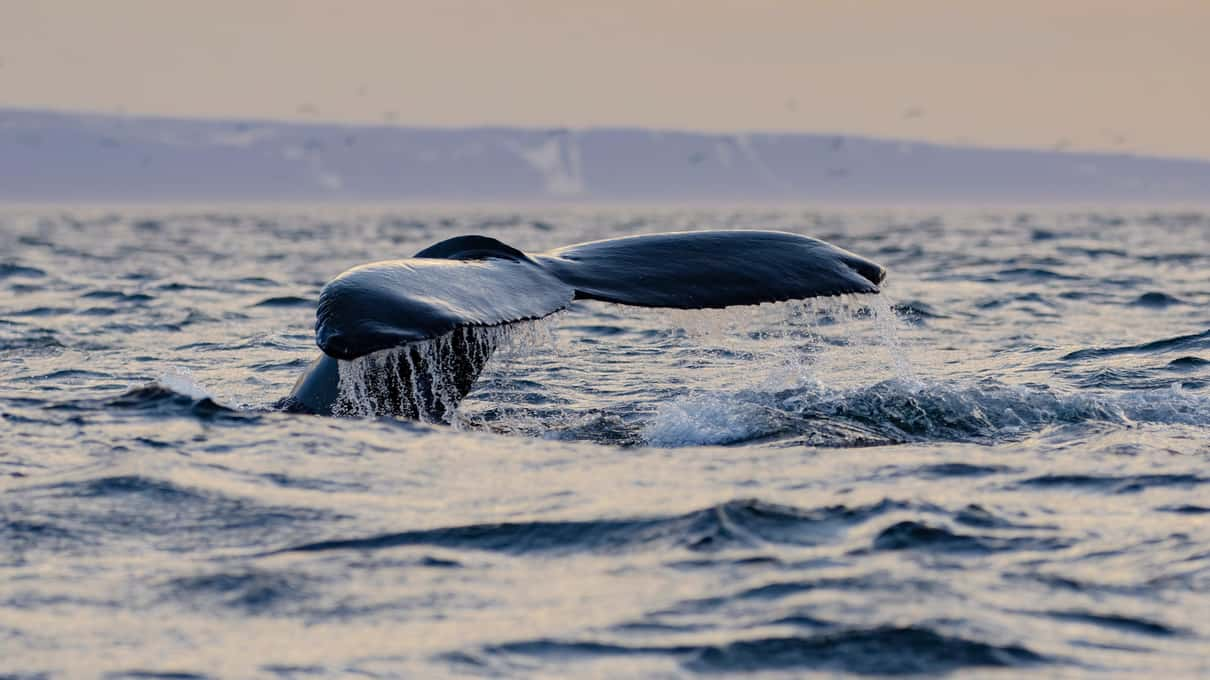
For cameras the twilight is soft and unusual, but slow. A moving fin in grey water is hard to freeze, so a fast lens helps more than a long one in December.
Midwinter storms and cold
Daytime temperatures on this coast usually sit a few degrees below freezing, and the sea does not freeze. Out on the water the wind and spray make it feel much colder than the number suggests.
Storms are more likely in the middle of winter, and an operator will cancel when the sea is too rough. What happens to your money then, and how to give yourself a second chance, is in our plan B guide for storms and empty seas.
The cold is easier to deal with than the wind. Our list of five layers for a Skjervøy whale boat also says which tours hand out flotation suits.
Christmas and New Year fill up first
The holiday weeks around Christmas and New Year are the busiest of the winter. Boats with small groups sell out sooner, and a bed in a small town like Skjervøy can be harder to find than in Tromsø.
If your dates are fixed, book early. Free cancellation until a day before departure is standard on most GetYourGuide listings (check yours), so an early booking costs little if your plans change.
Leave a buffer day
The most useful thing you can add to any week is one spare day. Weather cancels trips, and a quiet day at sea sometimes ends with distant fins only.
If you sleep in Skjervøy, a retry is easy. Dervola's heated cabin cruiser, from ~$284, meets at 9:30 am at Skjervøy Marina and is back about 2 pm, so a second trip the next morning fits without fuss.
A long season and a warm cabin
Dervola Adventure names the longest season of the tours here, October to February. Its heated cruiser has indoor seats for up to 16 guests and rates 4.7 from 70+ reviews on GetYourGuide. You have to reach Skjervøy yourself.
From Tromsø the sums change. Arctic Adventure Tours' RIB day, from ~$343, fills about 12 hours from a 05:00 bus, so a retry means another early start on another day.
Green Gold of Norway's day from Tromsø, from ~$365, is the other long option. Its catch for planning is that its listing ends the season in late January, and it is the dearest of the five tours we compare.
Whether to base yourself in Tromsø or in Skjervøy is the bigger choice, and our comparison of the two starts walks through it. The drive itself, with the ferry, is in our Tromsø to Skjervøy route guide.
Choosing your week
- November to January is the usual core, with no promise of whales in any week
- Late October and November for daylight and photos, December for the deepest polar night
- Book early for the Christmas and New Year weeks
- Add a buffer day, ideally in Skjervøy, where a second boat is a short walk away
- For an evening aurora on the same trip, see whales at noon and northern lights at night