Why orcas and humpbacks winter off Skjervøy
The whales off Skjervøy are there for one thing, and it swims in schools of millions. Once you see how the herring ties orcas and humpbacks to the same patch of sea, a grey winter fjord gets much easier to read. This guide covers how each whale feeds and what you can expect to see from the boat.
Follow the herring, find the whales
Every winter, vast schools of Norwegian spring-spawning herring move into sheltered northern fjords to wait out the dark months. In recent winters they have gathered in the waters around Skjervøy, a fishing town on an island north-east of Tromsø.
The orcas and humpbacks come for that fish. Where the herring settles, the whales settle with it, which is why boats from Tromsø now drive about four hours north before anyone steps aboard.
The herring keeps no permanent address. In earlier winters it lay in fjords much closer to Tromsø, and it can shift again from one year to the next. The listings name a window from about October or November to January, and Dervola runs on into February.
Our guide to the Skjervøy whale season follows those months in detail. If you are still deciding on a base for those weeks, Tromsø day trip or Skjervøy harbor start compares the two options.
Orcas, the hunters in black and white
An orca is the largest member of the dolphin family, though most people grew up calling it a killer whale. The black back and the white patch behind each eye stand out even in the flat blue light of a northern noon.
Adult males carry a straight dorsal fin that can stand about 1.8 m (6 ft) tall, so a big male is often the first animal anyone spots. Females and young orcas have shorter fins with more of a curve, and a family group usually surfaces close together.
In Norway, orca pods tend to hunt herring as a team. The pod circles a school and drives it into a tight ball near the surface. Then single orcas slap the ball with their tails to stun the fish and pick them off one at a time.
Researchers call this carousel feeding. From a boat you mostly catch the edges of it, with fins turning in a loose ring and gulls dropping onto the scraps. Much of the action happens out of sight below the surface.
Humpbacks at the same schools
Humpback whales feed on the same herring in a completely different way. Instead of herding, a humpback lunges up through a school with its mouth wide open, then pushes the water back out through its baleen and keeps the fish.
On a calm day you often hear a humpback before you find it. The blow is a loud, wet exhale that carries far over still water, and the column of spray hangs in the cold air for a few seconds.
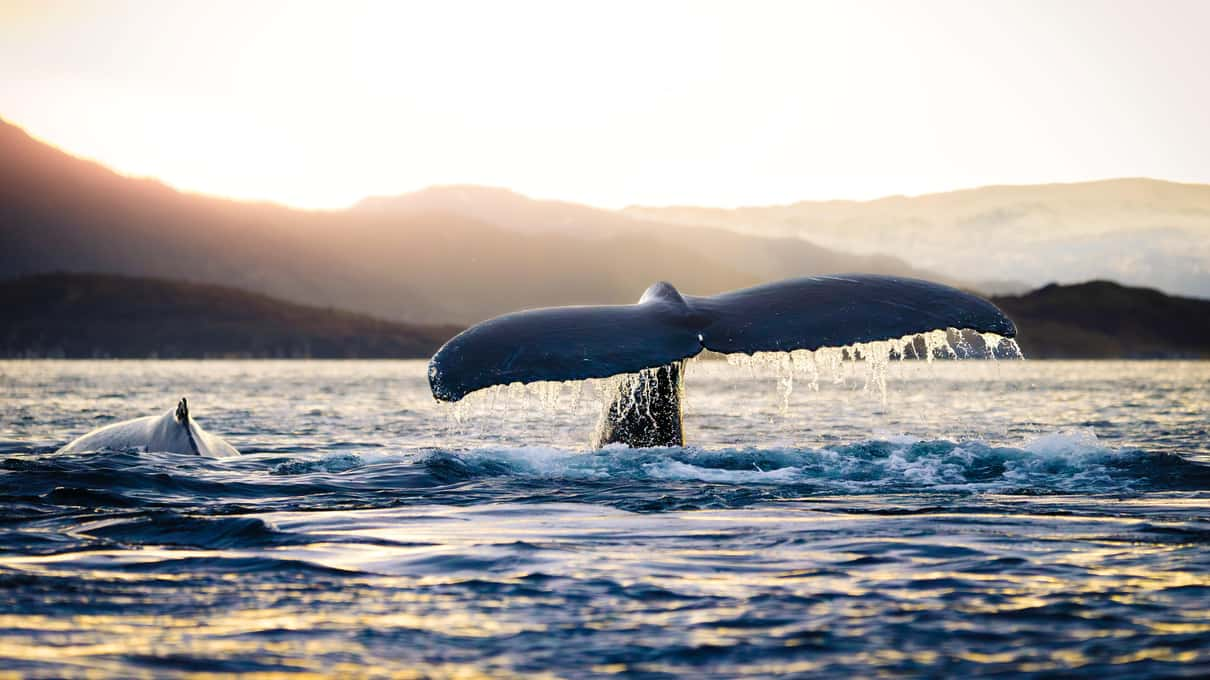
When a humpback dives deep it often lifts its tail fluke clear of the sea. The black and white pattern on the underside differs from whale to whale, which is why researchers use fluke photos to tell individuals apart.
Orcas and humpbacks can feed in the same stretch of fjord on the same morning. A crowd of birds low over the water usually means herring near the surface, and either kind of whale may be underneath it.
Other animals in the fjord
Now and then a fin whale joins the feeding. It is long and fast, and usually shows little more than a tall blow and a slim grey back before it slides under again.
Skua Nature also names minke whales on its species list, next to the fin whales. Minkes are smaller and tend to keep to themselves, so count one as a bonus rather than something to expect.
Look up as well as down. White-tailed eagles live along this coast all year and often circle over the feeding, while flocks of gulls mark the spots where the herring has been pushed up.
What you see and hear from the deck
Most of a whale trip is fins and blows rather than whole animals. You watch the curved back of a humpback roll forward, or a row of orca fins cut across the water toward the boat.
With luck a whale breaches, throwing most of its body clear and landing with a crash you hear a moment later. Nobody can call a breach in advance, so keep your eyes up rather than on your camera screen.
Sound matters more than people expect. In still air the blows carry a long way, and Dervola's skipper-guides may lower a hydrophone to let you listen below the surface when the situation is right. It is never promised.
Listening in from a warm cabin
Dervola Adventure leaves Skjervøy Marina at 9:30 am for about four hours in a heated cabin cruiser, with a flotation suit included and a hot drink with waffles on board. It rates 4.7 from 70+ reviews on GetYourGuide, from ~$284.
Dervola's listing calls Skjervøy the place of the largest gatherings of orcas in the world. Treat that as the operator's own description rather than a counted fact. Numbers change from day to day, and no listing guarantees a single whale.
How close the boats go
The operators say they keep a respectful distance and let the whales choose how near they come. Skua Nature cites ethical guidelines for whale watching on its listing.
So nobody can promise a close pass. Sometimes a curious orca surfaces beside the hull, and sometimes the whole morning is watched from a few hundred meters away. Skua suggests bringing a telephoto lens if you own one.
The boat changes the view as well. On an open RIB you sit low near the water, while the cabin boats give you a deck or terrace higher up. Our guide to open RIB versus heated cabin boat compares the two.
Reading your own day out there
No listing promises whales, and every one of them says so plainly. The herring can move overnight, and on some days the orcas travel fast without stopping to feed.
If the sea comes up empty, rough sea or no whales off Skjervøy covers what happens next. For the cold, read five layers for a Skjervøy whale boat before you pack, and check who can join a Skjervøy whale tour if you travel with children.
The boats work in the short midday light, and the same dark skies sometimes bring the aurora at night. Whales at noon, northern lights at night explains how to fit both into one trip, and our cost guide prices every option.