Open RIB versus heated cabin boat off Skjervøy
Whale boats at Skjervøy come in two kinds. Open RIBs are fast and low, with spray in your face, while heated cabin boats give you a warm room to retreat to and a deck to watch from. The choice shapes the cold and the motion far more than the price.
Two kinds of hull
A rigid-hulled inflatable boat, or RIB, is a fast open boat with a solid hull and inflated sides. Frozen Frontiers and Green Gold of Norway use one too, like our pick.
Neither kind is better at finding whales. Both sail the same water, so the choice comes down to how you want to spend the hours at sea.
The heated boats are larger and covered. Skua Nature sails a new covered boat with a heated cabin, and Dervola Adventure uses heated cabin cruisers with seating inside and out.
On an open RIB
A RIB sits low, so when an orca surfaces you see it close to eye level. It is quick between pods, which helps when the whales cross a fjord at speed.
The trade is exposure. Wind and spray reach you for the whole trip, about 3 hours on Arctic Adventure Tours' day from ~$343 and on Frozen Frontiers' harbor RIB from ~$241.
Speed also means wind chill. Even on a calm day the boat makes its own breeze, and at a few degrees below freezing that air bites through anything that is not windproof.
Every RIB operator here hands out a flotation suit with boots and mittens, plus goggles. Frozen Frontiers stocks its insulated suits from XS to XXL, so most body sizes are covered.
The entry rules are strict, because a RIB bounces hard in waves. Nobody under 14 or shorter than 140 cm (4 ft 7 in) may join. Pregnant guests and anyone with back problems are excluded too, and Frozen Frontiers also asks for a general fitness level.
On a heated cabin boat
Skua Nature's heated boat from ~$279 is brand new, and its larger hull makes it more stable than a RIB. You watch from the warm cabin or step onto an open observation terrace, and no special suit is needed.
It carries up to 12 guests. Besides the captain, who also sails in Svalbard, the crew includes a nature guide trained as an ethologist, and wildlife photographers on board give photo tips.
Dervola Adventure's cabin cruiser from ~$284 offers indoor and outdoor seating and dry storage for camera bags. You still get a warm flotation suit with footwear and gloves for time on the open deck.
Dervola takes up to 16 guests, the most of the harbor boats. When the situation is right, the skipper may lower a hydrophone so you can hear the whales under water.
Hot drinks and snacks are part of Skua's trip, and Dervola serves a hot drink with waffles. On the RIBs the warm food waits until you are back on shore or on the bus.
Warmth between sightings
Skua Nature's covered boat gives you a heated cabin to step into and an open terrace for the fins, sailing from Skjervøy with up to 12 aboard.
Seasickness and motion
Motion is the biggest difference between the two. A RIB bounces over every wave, while a larger covered boat rolls more gently, though no boat is still in a winter swell.
Frozen Frontiers says its RIB is unsuitable for anyone who gets seasick easily. Skua advises anyone susceptible to take seasickness medication roughly 2 hours before sailing, which is sound advice on any boat here.
If you have never been on a small boat in open water, the covered boat is the safer bet for your stomach. Our guide to rough days covers seasickness in more detail.
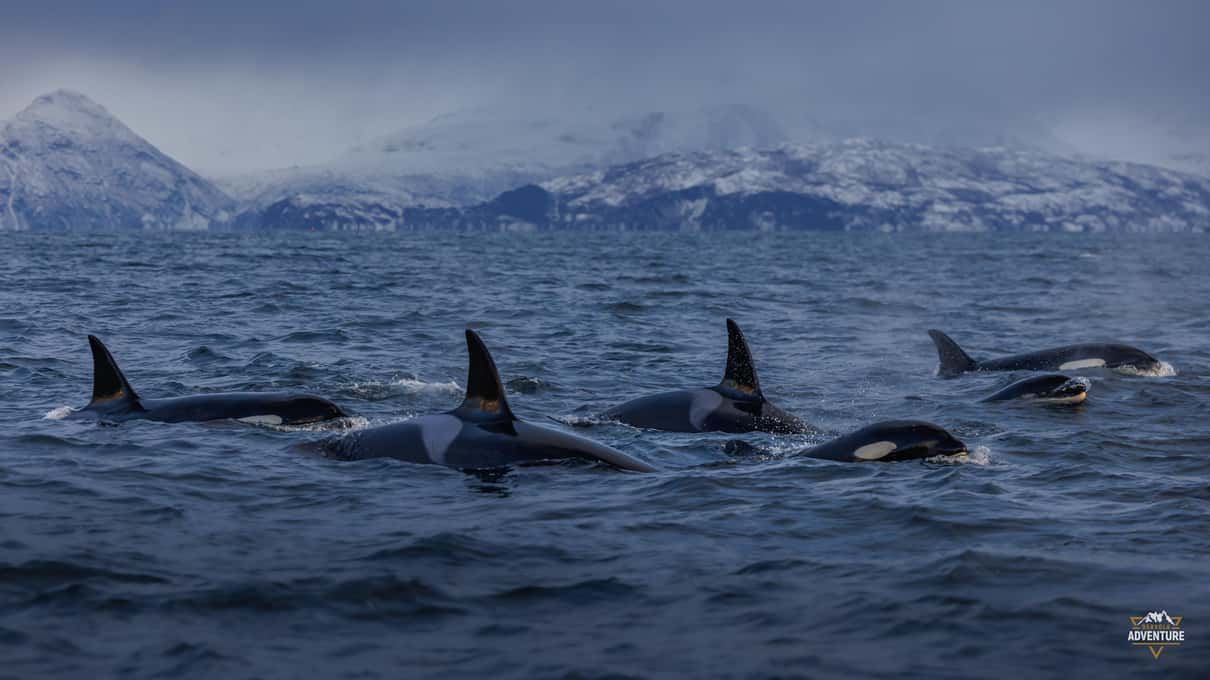
Photos from each deck
From a RIB your camera sits close to the water, which gives low angles on a dorsal fin. Spray and bouncing make sharp shots harder, so wipe the lens often and keep the camera in a waterproof bag between sightings.
The cabin boats put you higher up on a terrace or deck, which helps you spot a pod coming and frame a humpback fluke. Skua suggests a telephoto lens if you have one, and Dervola's dry storage keeps spare gear out of the spray.
On either boat the cold drains batteries fast, so carry a spare in an inside pocket and swap it in when the first one fades.
Cold, comfort and age limits
On a RIB you stay outside the whole time, warm only as long as your suit and layers hold. On a heated boat you can go inside between sightings, which counts for a lot over 3–4 hours near the polar night.
The cabin boats are also the only choice here for younger children. Skua takes children from 6, and we found no age limit on Dervola's listing, so check it before you book; our age and health guide has every limit.
Which boat suits you
- Want speed, spray and fins at eye level? An open RIB
- Coming from Tromsø without a car? The RIB on our pick's bus day
- Prone to seasickness or worried about the cold? A heated boat
- Traveling with children under 14? A heated boat from Skjervøy
- Carrying a big camera kit? Dervola's dry storage or Skua's terrace
Both kinds head into the same waters, and whales are never guaranteed on either. The harbor boats need you in Skjervøy first, so read the road guide and the start-point comparison before you pick a hull.
Price differences between the boats are smaller than you might expect, as the cost guide shows. For the RIBs, dress with care using our layering guide.